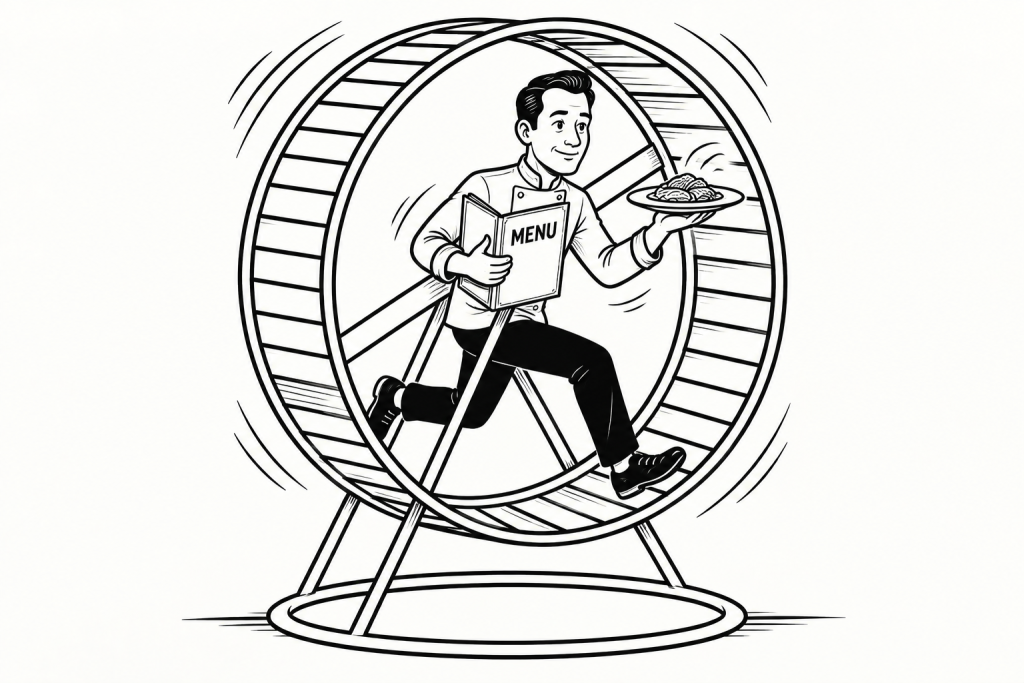
Are You Moving Your Restaurant Forward, or Just Keeping Everything Moving?
You can work hard all day and accomplish a lot without getting much closer to the restaurant you really want.
Orders still have to go out. Employees call in. Customers complain. Something breaks. A vendor doesn’t show. Costs creep up. Somebody needs an answer. By closing time, you may have solved a dozen problems and created three more things to deal with tomorrow.
My wife and I knew that feeling from our own restaurants. We could spend an entire day solving problems and still wonder at closing what we had actually done to make tomorrow’s restaurant better than today’s.
None of that means you are doing anything wrong. Much of it has to be done.
But every once in a while, it makes sense to stop running long enough to ask a different question:
What would it take to turn the restaurant you have into one you’d be proud to show off?
What Would a Better Restaurant Look Like to You?
Maybe you want to make substantially more money without necessarily increasing sales.
Maybe you want better service, fewer mistakes, and more consistency from one shift to the next.
You may want employees and managers who know what is expected of them and can make more decisions without coming to you.
You may simply want to be able to leave the restaurant without wondering what will happen while you’re gone.
Or you may be thinking about selling someday, turning the restaurant over to someone else, opening another location, or perhaps even franchising.
Your list may be entirely different, but you know you don’t want to or can’t remain where you are forever.
Standing Still Really Isn’t Standing Still
Restaurants don’t stand still. Costs change. Customers change. Employees change. Competitors change. What worked well a few years ago may work less well today, and small problems have a way of becoming larger ones when nobody has time to deal with them.
But that doesn’t mean you should start changing things simply for the sake of change.
In fact, one of the most expensive mistakes you can make is trying to fix a problem before you understand what is actually causing it.
One thing I wish we had understood better in our own restaurants was the value of stopping long enough to understand what was really happening before trying to fix it. We could have saved ourselves a lot of time, money, and aggravation.
So where do you start?
Give Yourself Ten Weeks to Turn Things Around
This isn’t ten weeks because there are ten weeks of lessons to sit through. Most of the work takes place in your restaurant, between the lessons.
You need time to observe what is actually happening, decide what you want instead, involve the people who will help make it happen, adjust the way things are done, see what happens, and make further adjustments based on what you learn.
We divide that work into five two-week periods. Each gives you enough time to work with what you learn before moving on to the next part.
Weeks 1–2: Observe What You Have and Decide What You Want Instead
Start by looking closely at the restaurant you actually have. Observe different days and shifts, talk with the people who see things you may not, review what customers are telling you, seek advice from suppliers and industry professionals, and look at what your numbers and other information show.
Food cost, waste, and ordering are almost always a good place to start, and make for easy wins.
Pay special attention to your people and their needs. You will use this to motivate them to help you make the necessary changes.
Write down everything you observe and learn. This becomes your inspiration when you next work on what you what to become.
Developing a clear picture of the restaurant you want instead of the one you have is the most important part of the turnaround. Without it, you cannot make the necessary changes, and you will not be able to align your people.
Weeks 3–4: Align Your People
Now look at the people who will have to help get you there. Determine what they need to understand, what is expected of them, what they are capable of doing, and where responsibilities, authority, skills, communication, or attitudes may need to change.
Most importantly, get rid of negative influencers before you hire and train new staff. Make it abundantly clear that the “old ways” will not be tolerated. Next to gaining a firm understanding of where you want to go, making sure you institute the right culture is your most important turnaround task.
Weeks 5–6: Adjust Your Systems
During your initial observations, and while determining what you want in your restaurant to become, you have already decided which systems and procedures support the restaurant you want, which ones get in the way, what is missing, and what should be changed, simplified, added, or eliminated.
This is usually the most comprehensive part of a turnaround, and the one inviting most opposition, so make sure you do this gradually. Let one change take hold before you introduce the next, and celebrate each successful change.
Weeks 7–8: Test and Continuously Adjust
After you have put most of the required changes to work, watch what happens. Some will take. Some won’t. Others will produce consequences you didn’t anticipate. Keep what works, adjust what doesn’t, and continue learning from the results.
Weeks 9–10: Re-observe and Fine-tune
Now look at the restaurant again with much the same discipline you used at the beginning. Compare what is actually happening with what you wanted to happen. Test if you can step away from the day to day grind without losing momentum. Fine-tune what still needs work and decide what comes next.
We Wish We Had Known This Then
Our own restaurants taught us a great deal, but they could only show us what happened in our restaurants.
Beginning in 1981, my work took me into hundreds of other businesses. I later personally structured or supervised about 300 franchise programs, roughly half in the restaurant industry, and eventually became increasingly involved in turnaround, restructuring, and growth.
That gave me the opportunity to see many variations of the same circumstances. More importantly, it showed me why something that works beautifully in one business can be exactly the wrong answer in another.
The methods you’re about to see grew out of that experience. And we’re still learning.
The Method Behind the Ten Weeks
The ten-week roadmap is organized around a method we call 3R2A: three Rs followed by two As. These are the five main components (Current Reality, Write, New Reality, Align, Adjust) we use to move from understanding the restaurant you have to building and refining the restaurant you want.
When any part needs closer examination, we use what we call the 7CS technique: What, When, Where, Who, Why, In What Way, and By What Means. You don’t have to run every question against everything, but, when you use them all, you can be quite certain you have considered that circumstance from every possible angle. You use them when you need to get beneath an observation, assumption, problem, or proposed solution.
The names aren’t particularly important. What matters is how you use them.
Let’s start with your Current Reality and show you exactly what we mean.
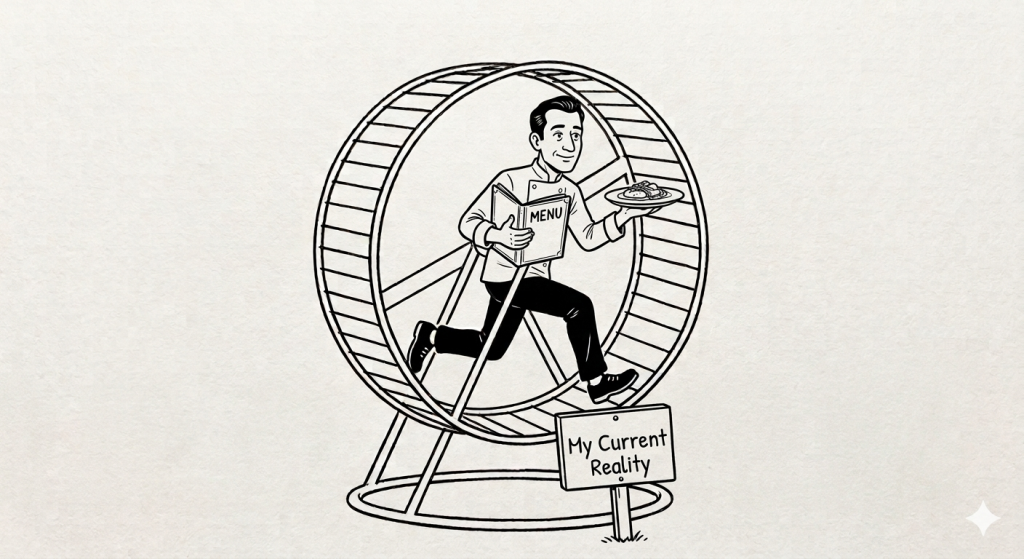
My Current Reality
For now, don’t try to improve your restaurant. Your first job is to understand the restaurant you actually have.
That requires more than working another week and paying closer attention. You are already in the restaurant every day. The challenge is to stop seeing only what you expect to see and begin observing deliberately.
Watch different days and different shifts. Watch busy periods and slow ones. Watch what happens before service, during service, between rushes, and at closing. Whenever possible, find out what happens when you aren’t there.
Don’t limit your research to what you can see yourself. Talk with your employees and managers. Ask customers. Talk with suppliers and other people who know your restaurant or your market. Read your reviews. Study your sales, food cost, labor, waste, ordering, and other numbers.
And pay particular attention when two sources tell you different things. Your numbers may contradict what you believe. Employees may describe something differently from your manager. Customers may care about something you hardly notice.
Over the years, I’ve learned to pay particular attention to contradictions. They are often more useful than agreement because they tell you there is something you don’t yet understand.
Don’t decide too quickly which one is right. Find out why they are different.
That’s where your Current Reality begins to become useful.
Don’t Stop at the First Answer
Suppose one of your observations is:
“Everything seems to fall apart when I’m not here.”
That’s useful to notice, but it isn’t yet useful enough to act on. “Everything,” “fall apart,” and even “when I’m not here” can mean many different things.
Start with What. What actually happens differently when you’re gone? Orders take longer? Food quality changes? Employees stop doing certain tasks? Customers complain? Discounts increase? Closing isn’t completed properly? Decisions are postponed until you return?
Then ask When. Does it happen every time you leave, only during busy periods, on particular shifts, when certain employees are working, or when something unusual happens?
Where does it happen? In the kitchen? At the counter? In the dining room? During receiving? At closing? Or does the problem move from one part of the restaurant to another?
Who is involved? Who normally handles the work? Who makes the decisions when you’re there? Who is supposed to make them when you’re gone? Who has the necessary information, authority, and ability?
Then comes Why. Why does your presence make a difference? Are you providing knowledge nobody else has? Making decisions nobody else is authorized to make? Correcting mistakes? Setting the pace? Resolving disagreements? Or have people simply learned that waiting for you is easier than deciding for themselves?
In What Way does the work change when you’re absent, and By What Means is it presently being accomplished when you’re there?
By now, “Everything falls apart when I’m not here” may have become several quite specific circumstances, each with a different cause and potentially a different solution.
And that is the point. Don’t solve the sentence you started with. Understand the circumstances behind it.
Now you have more clearly defined your Current Reality on this point, which allows you, in turn, more clearly to define your New or Desired Reality when you come to that.
But this was only one observation.
Over a couple of weeks of deliberately observing your restaurant, you should uncover many more. Some will concern customers. Others will involve employees, managers, food, service, costs, purchasing, waste, scheduling, facilities, marketing, communication, or the way decisions are made.
Some observations will turn out to be important. Others won’t. Some will be connected in ways you didn’t expect. And some of the things you were certain about when you started may look quite different after you’ve examined them more closely.
You aren’t going to keep track of all of that in your head.
The Second R Is Write
From the beginning, write down what you observe and what you learn.
Record what happened, what other people told you, what the numbers showed, what questions remain unanswered, and what you discovered when you looked more closely. When you use the 7CS to examine something, record those answers too.
Writing does more than help you remember. It forces you to be more precise. It lets you compare what you observed on different days and shifts. It helps you see contradictions, patterns, and connections that are much harder to recognize when everything remains in your head.
The Course Includes a Workbook to Help You Do This
When you take the Showcase Restaurant Blueprint course, you receive a workbook along with instructions for how to use it throughout the turnaround.
It gives you a structured place to record your observations, organize what you’re learning, work through questions that need closer examination, and gradually build a written picture of the restaurant you have and the restaurant you want.
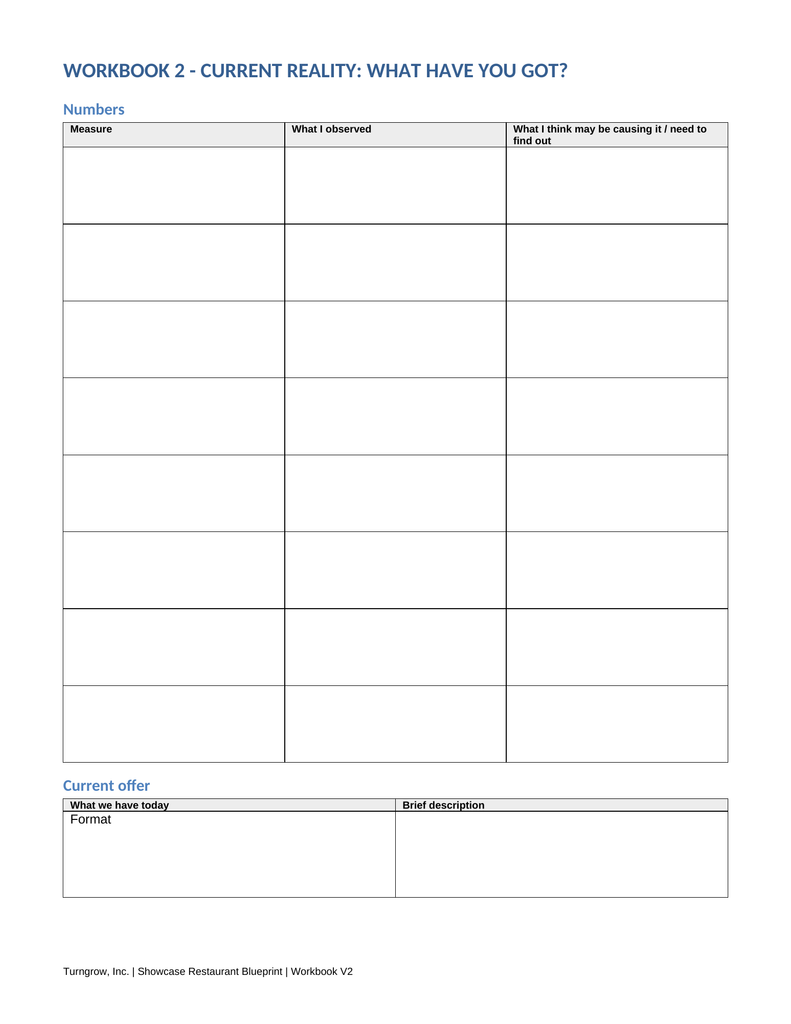
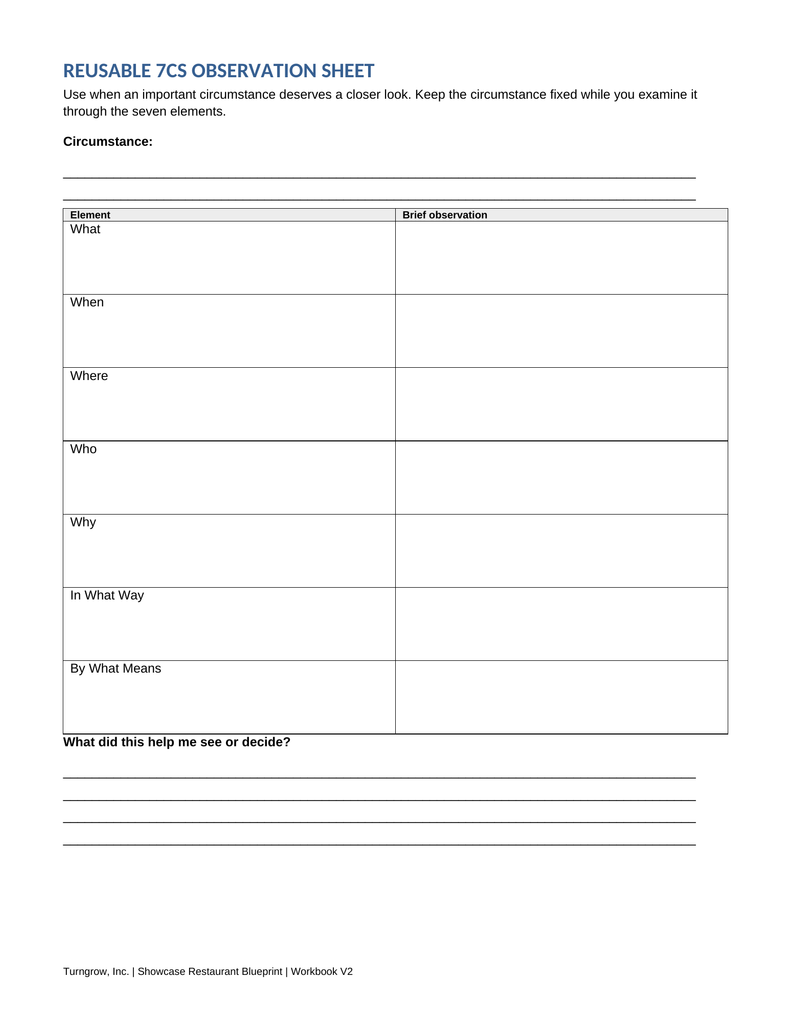
These are working pages, not reading material. You use them to capture what you discover and drill deeper when something needs a closer look.
What Happens From Here
You have now seen how the process begins. In the course, you continue from Current Reality and Write through the remaining parts of the turnaround, adapting the process we have shown you to each part
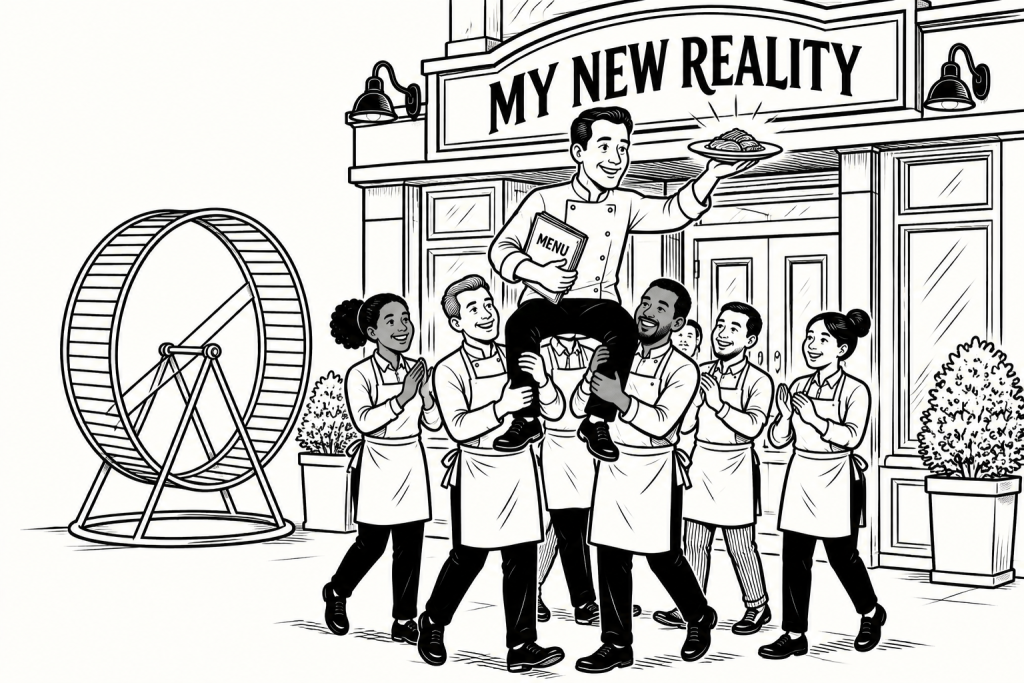
Define Your New Reality
This is the most important part of the turnaround. You develop a clear picture of the restaurant you want instead of the one you have, so the decisions that follow have a destination rather than simply being a collection of improvements.
Align Your People
Next, you bring your people into alignment with that New Reality. You determine what they need to understand, what is expected of them, who can take on greater responsibility, what capabilities need to be developed, and what attitudes or negative influences stand in the way. You work deliberately on creating the culture needed to support the restaurant you are building.
Adjust Your Systems
This is usually the biggest job. You work through the systems and procedures that make the restaurant operate, deciding what should be kept, changed, simplified, added, or eliminated. Rather than changing everything at once, you introduce changes gradually enough to see what actually works.
Implement, Test and Adjust
You put the changes to work under real restaurant conditions and watch what happens. You keep what works, correct what doesn’t, deal with consequences you didn’t anticipate, and continue adjusting until the new way begins to become the normal way.
Observe Again and Look Ahead
Finally, you step back and observe the restaurant again much as you did at the beginning. You compare where you are with the Current Reality you recorded and the New Reality you set out to create. You determine what has changed, what still needs work, whether the restaurant can operate with less dependence on you, and what you want to accomplish next.
If we had had this process when we were operating our own restaurants, I believe we would have saved ourselves considerable time figuring some of these things out. That’s really the reason for putting it into a course.
You can work much of this out yourself. We did. The question is whether you want to spend the time doing that.
There Is No Offer Stack
You have already seen what you’re getting.
You get the complete Showcase Restaurant Blueprint course, the workbook and instructions for using it, and the process for working through your restaurant over approximately ten weeks.
There aren’t six bonuses added to make the offer look bigger. There isn’t a fictitious value assigned to every part of it. And there isn’t anything important being held back so we can sell it to you later.
The price is $197.
If what you’ve seen on this page makes sense, the question is simply whether having the complete process will save you enough time, mistakes, and trial and error to make $197 worthwhile.
A 30-Day Money-Back Guarantee
Work with the course. If, during the first 30 days, you conclude that it isn’t delivering what we represented on this page, tell us why and we’ll refund your purchase.
We do ask for a real reason. “I changed my mind” or “I never got around to using it” isn’t one. You don’t have to prove that the course failed, and you don’t have to agree with us. Just tell us what didn’t work for you or where you believe it fell short of what we promised.
Showcase Restaurant Blueprint
Complete 10-week course and workbook
$197
Secure checkout. Immediate access after purchase.
© 2026 Turngrow, Inc. | Privacy Policy | Terms & Conditions